


64% of Georgia Executives Are Investing More in Generosity. Here’s How to Help Employees See It.
Friday, November 6th, 2026
Executives are investing in generosity at near-record rates — 99% are increasing or maintaining their commitment, but recent data shows that most employees haven’t noticed.
This week, we dig into how executives and employees define generosity, and the difference may be costing companies the returns generosity is supposed to deliver.
Executives and Employees Are Prioritizing Generosity Differently
When asked what they think of first when considering business generosity, employees and executives are moving in different directions.
For employees, generosity starts with the everyday work environment. Employee care leads in their response (38%), then company culture and values (27%), followed by how the business treats customers and people in its supply chain (20%), and only then charitable giving to the broader community (15%).
For executives, the answer is the opposite — charitable giving is their top association when they think about business generosity (34%), followed by company culture (25%), business operations (21%), and finally, employee care ranks last (20%).
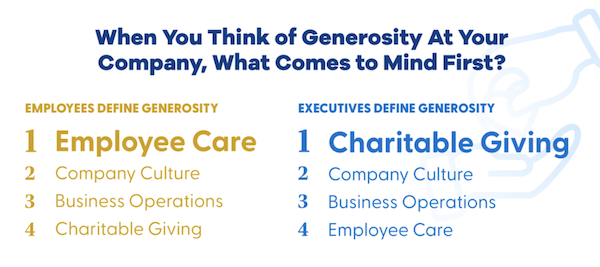
In 2026, this gap widened. Employees’ emphasis on employee care rose (35% → 38%) while their emphasis on charitable giving fell (17% → 15%). Executives moved in the opposite direction. For them, employee care fell (25% → 20%) while charitable giving rose (32% → 34%). Two groups, the same survey, drifting further apart on what “generous” really means.
That difference helps explain an important gap in the data. 64% of executives say they are increasing their investment in generosity, while 40% of employees notice an increase.
Why It’s Worth Bridging the Gap
When employees do experience generosity, the returns show up in daily work: 90% say they’re better able to engage with customers, 89% say they’re more engaged and productive, and 88% say they want to work harder and find new ideas. 55% have made a financial sacrifice to work for or stay at a generous company. In turn, employees help champion the business’s generosity externally, extending the reach of any charitable efforts. See more about the impacts.
What Employees Are Actually Looking For
To be clear: they are not requesting a bigger benefits package. The generosity they rank highest are things they experience during the workday.
- Focus on their daily experiences. Employees’ top priorities are things they encounter every day at work. Leaders who communicate openly and welcome input lead company culture (45% name it a top-two priority), and genuine care for customers leads business operations (51%). A flexible work schedule leads employee care (49%), with mental health support among the next most important (29%). Executives already offer these at high rates, and most don’t require bigger budgets. What employees are asking for is a consistent throughline: generosity that shows up daily in employee care, company culture, and how the business operates.
- AI transparency. Employees aren’t looking for guarantees about what AI will do. They’re asking to be told what the company knows as it learns it, to have a voice in how AI is adopted, and to have time to adapt as the work changes. 53% rank at least one of these among their top culture priorities.
- Make community giving personal. Employees’ top community priority is paid time to volunteer, just ahead of financial contributions. Fewer than half of companies (48%) offer PTO to volunteer. A company-organized volunteer day expresses the company’s values, but paid time to volunteer for a cause an employee picked honors their values. Employees feel that distinction.
The 2026 Business Generosity Report gives executives a category-by-category benchmark of what employees find most meaningful and where executive investment will find the highest-return. The commitment is already there. The data shows where to direct it.

